Gold Price $5114.21
TSX-V: AUMB
Last: 1.11
OTCQX: AUMBF
Last: 0.82
FRA: 2KY
Last: 0.75

True North Complex

As 1911 Gold’s flagship asset, the True North Complex is a key component of our overall corporate strategy to develop a district-scale gold exploration and mining operation around a centralized ore processing facility in the Rice Lake greenstone belt.

The True North Complex includes a modern, fully-permitted 1,300 tonnes per day processing facility, tailings management area and reprocessing operation, underground mine infrastructure (currently under temporary closure), and the True North Gold Deposit.
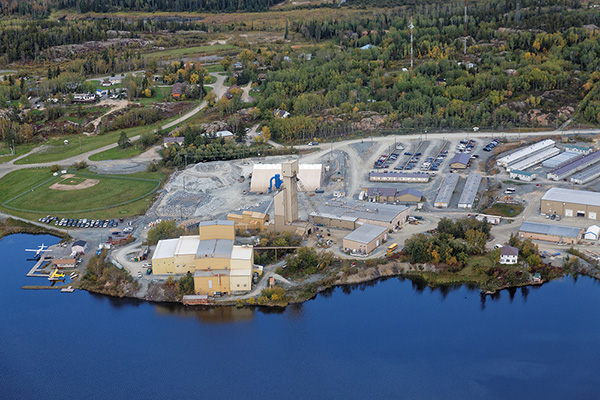
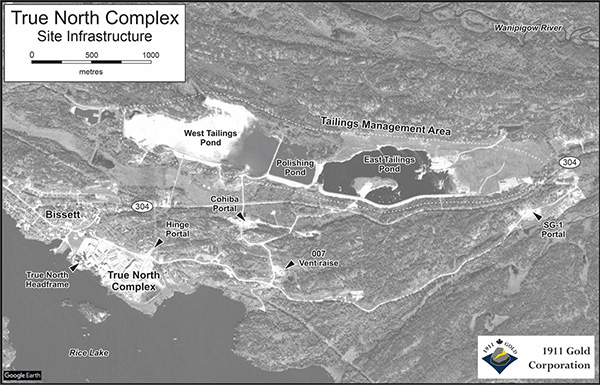
Site photo

Site Aerial View

Existing infrastructure at True North, combined with the high-grade mineral resource, provides a solid foundation on which to build a modern long-life mining and processing operation. The site also includes the necessary infrastructure to maintain operations, including all-season road access, grid hydroelectric power and broadband communications, as well as on-site maintenance shops, assay laboratory, warehouse, fuel storage facilities and administrative offices. The site also includes a 200-room camp facility, including kitchen, dining, recreation and fitness facilities.

The True North Complex is located adjacent to the town of Bissett on the north shore of Rice Lake, approximately 150 kilometres northeast of the capital city of Winnipeg, Manitoba. It is situated on mineral dispositions held 100% by the Company, comprising two contiguous Mineral Leases (ML63 and ML13433), totaling 1,092 hectares.

The original gold discovery in the Rice Lake district was made in 1911 by Duncan Twohearts, an indigenous trapper from the Sagkeeng First Nation, who identified an outcropping of vein quartz on the north shore of Rice Lake – the discovery outcrop for the True North Gold Deposit. Duncan Twohearts wrapped his find in a piece of blue denim, marking the first significant discovery of gold in the Province of Manitoba.

The original mining claim, named San Antonio, was staked on May 17, 1911, followed in August 1912 by the establishment of a small stamp mill on the adjacent Gabrielle mining claim – the first gold mill erected in Manitoba. Subsequent mine developments in the Rice Lake district took place in two main stages (1923–1968 and 1998–2017), with 23 zones eventually recording production, amounting to approximately 2.3 million ounces of gold.

Of historical note, the True North mine has produced more than 2 million ounces of gold over a mine life that has spanned close to 100 years, including 36 years of continuous production (1932–1968) from the historical San Antonio Gold Zone.
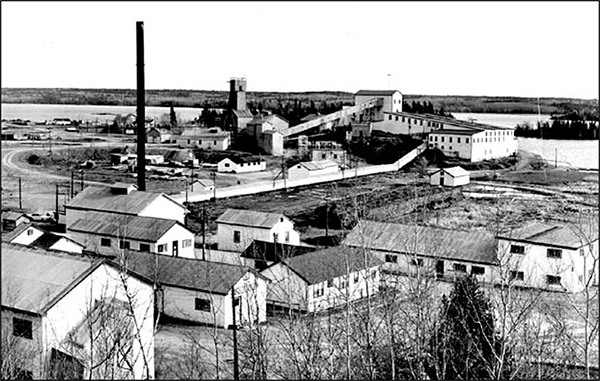
historical photo of the san Antonio mine

The True North Complex includes a modern, fully-permitted 1,300 tonnes-per-day ore processing facility, comprised of crushing, milling, centrifugal gravity concentration and flotation circuits. Concentrates from the gravity circuit are upgraded on a shaker table for direct-smelting, whereas flotation concentrates are reground, thickened and then leached in a three-stage leach circuit. Dissolved gold is recovered by six-stage carbon-in-pulp (CIP) circuit, followed by conventional pressure strip, electrowinning and smelting in an electric induction furnace. Gold is poured into doré bars and shipped to a refinery prior to being sold.
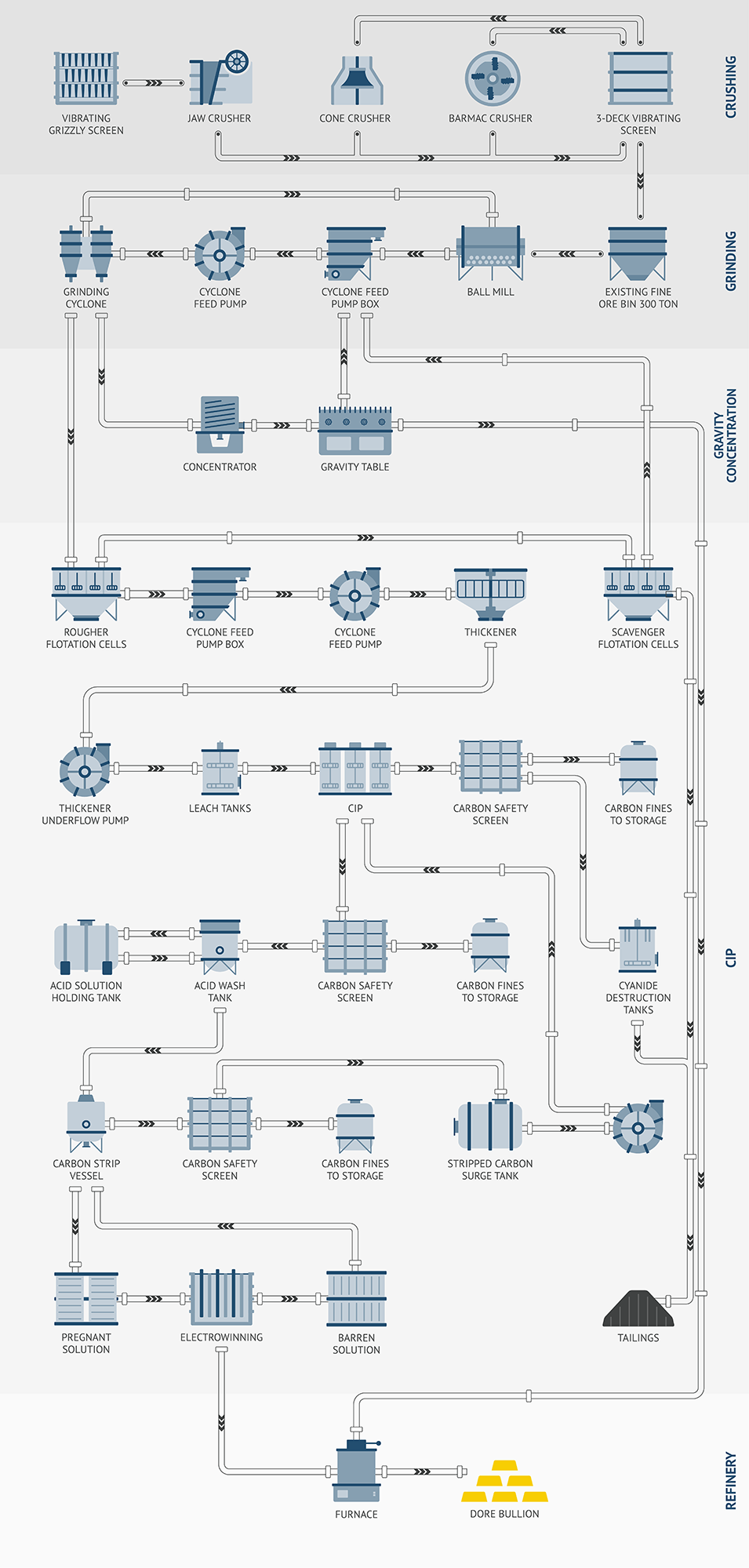
Detailed processing map

The original processing facility at the True North site, constructed in 1931–32, was destroyed by fire in 1980 and was subsequently reconstructed in 1996–97, with an operating capacity of 900 tonnes per day. Mill capacity was increased to 2,300 tonnes per day in 2011; however, it has since been scaled back to 1,300 tonnes per day. Additional crushing capability will return the plant to 2,300 tonnes per day capacity.

Current process plant recovery is name-plated at 93.5% based on a feed grade of 5.5 g/t Au, historically ranging up to 96–97% with higher feed grades from mined ore.

From 2018 through 2022, the Company recovered gold from historical tailings at Rice Lake, this seasonal (April to November) operation has produced approximately 24,742 ounces of gold. There is a remaining estimated resource of 15,166 ounces of gold.

Production from True North Tailings Operation:

  2017 2018 2019 2020 2021 2022
Tonnes Processed 80,848 230,427 222,134 224,475 269,829 182,746
Grade Processed 1.4 g/t 0.9 g/t 1.0 g/t 0.9 g/t 0.6 g/t 0.6 g/t
Gold Processed 3,616 oz 6,754 oz 6,917 oz 6,201 oz 5,466 oz 3,775 oz
Gold Recovered 3,285 oz 4,398 oz 6,081 oz 4,711 oz 3,763 oz 2,504 oz

Scroll right to view more

This operation utilized an excavator to windrow tailings within the Tailings Management Area (TMA) for dewatering and then loaded the material onto 36-tonne trucks for transport to the processing facility. Tailings were then off-loaded into a screened feed hopper and conveyed directly to the grinding circuit, bypassing the crushing circuit. Tailings were processed at a rate of 55 tonnes per hour with a target rate of 1,300 tonnes per day.

The TMA is located 1.6 kilometres northeast of the processing facility in an area naturally defined by bedrock ridges around the perimeter of a previously boggy area. It includes west and east impoundments, totaling 110 hectares in area, separated by polishing pond 11 hectares in area. The current dikes and embankments were constructed in stages to industry standards, beginning in 1996, with the most recent expansion completed in 2014.

Beginning in 1997, tailings containing unrecovered gold were pumped as slurry via pipeline to the TMA from the processing facility. The potential to economically reprocess these tailings to recover gold was identified after a review of drilling undertaken in 2014, which indicated an average grade of 1.47g/t Au. Additional sampling was completed in 2016 to evaluate the resource. Tailings reprocessing commenced in 2016 with a Probable Reserve of 1,062,000 tonnes at 0.96 g/t Au (containing 32,400 ounces of gold) and an Indicated Resource (inclusive of Mineral Reserves) of 1,940,000 tonnes at 0.82 g/t Au (containing 51,000 ounces of gold).

An updated Mineral Resource Estimate for the True North tailing reprocessing operation was produced in March 2018. Assay results from 138 auger and percussion drillholes spaced approximately 60 metres by 30 metres were used to model the tailings mineral resource. Details on the methodology of the Mineral Resource Estimate can be found in the Technical Report dated March 31, 2018.

True North Tailings Mineral Resources (March 2018):

Category Tonnes (k) Au opt Au g/t Au koz
Indicated 1,789 0.024 0.83 48
Inferred 28 0.024 0.81 0.7

Scroll right to view more

Underground infrastructure at the True North Complex includes the ‘main’ (True North) mine, accessed via a 1,219 metre two-compartment shaft (A-shaft), originally brought into service in 1934 and subsequently deepened to its present depth in 1997. An internal winze (D-shaft) and ramp system extend the workings in the main mine to 1,675 metres vertical depth and are connected to A-shaft via a 1,400-metre-long tramway on the 26th (1,190 metre) level. A-shaft is equipped with a modern headframe, dual-drum hoist and 4.5 tonne skip. Several ramp-access mines, including SG-1, Hinge and Cohiba, were developed between 2005 and 2010 on satellite deposits located northeast and east of the main mine.

Underground development at True North began over 100 years ago, when prospect shafts were sunk during the 1920’s and 1930’s on several gold showings, with the San Antonio (True North) mine being brought into commercial production. Elsewhere in the district, significant mine development and production took place between 1927 and 1951 at Central Manitoba, Gunnar and Ogama-Rockland, which have since been closed and partially reclaimed. Historically, shrinkage stoping was the principal mining method utilized in the district, although long-hole stoping and mechanized cut-and-fill were employed more recently at True North.
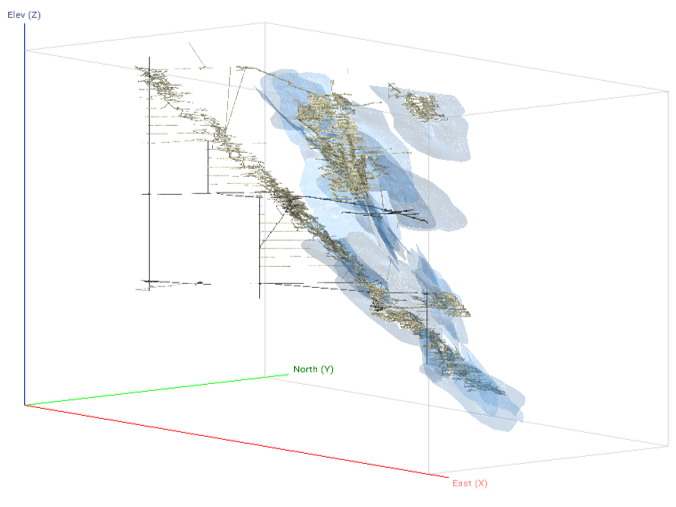
The True North Gold Deposit is a classical Archean orogenic gold deposit, consisting of quartz-carbonate vein systems hosted by brittle-ductile shear zones and faults in volcanic and sedimentary rocks (greenstones). The deposit is hosted by a north-younging, moderately inclined, succession of volcanic and sedimentary rocks, belonging to the 2.73–2.72 Ga Gem assemblage. At Rice Lake, this assemblage includes volcanic sandstone and conglomerate, tholeiitic basalt flows and gabbro sills and dacitic volcaniclastic rocks, intruded by various felsic porphyry dikes.

The most important host for gold mineralization is a layered gabbro sill known as the San Antonio Mine unit (host to the main True North or Rice Lake deposit), but significant mineralization is also hosted by overlying basalt flows (007, 710-711 and SG1 deposits) and dacitic volcaniclastic rocks (Hinge and Cohiba deposits). The South Gabbro unit has not been drill tested. Orebodies within these deposits were accessed via the True North shaft and underground tramway, or from surface declines, the latter including the Hinge, 007 and SG1 declines.

An updated Mineral Resource Estimate for True North was produced in 2024, based on data from 3,157 surface and underground diamond drillholes (30,525 assay samples), and 30,202 channel sample strings from underground workings (114,756 assay samples). Wireframe models were constructed for 66 vein sets. Details on the methodology of the Mineral Resource Estimate can be found in the Technical Report dated December ??, 2024.

True North Underground Mineral Resources

Table 1: Mineral Resource Estimate Reported within 2.25 g/t Au Mineral Resource Constraining Envelopes

Category Tonnes Au opt Au g/t Au oz
Indicated 3,516,000 0.142 4.41 499,000
Inferred 5,490,000 0.117 3.65 644,000

Scroll right to view more

Note: Mineral Resources are not Mineral Reserves and do not have demonstrated economic viability; there is no guarantee that all or any part of the Mineral Resource will be converted into Mineral Reserve.

Table 2: Block Model Sensitivity to Different Grade Thresholds within the 2.25 g/t Resource Constraining Envelopes

Sensitivity 


Gold Grade

Indicated Inferred
Tonnage Gold Grade Contained Gold Tonnage Gold Grade Contained Gold
(g/t) (t) (g/t) (oz) (t) (g/t) (oz)
2.00  2,781,000 5.23 468,000  4,852,000 3.96 618,000
2.25  2,530,000 5.54 451,000  4,404,000 4.14 587,000
2.50  2,255,000 5.93 430,000  3,754,000 4.45 537,000
3.00  1,751,000 6.85 386,000  2,726,000 5.10 447,000
3.50  1,368,000 7.86 346,000  2,031,000 5.75 375,000
4.00  1,093,000 8.91 313,000  1,527,000 6.42 315,000

Scroll right to view more

Note: The block tabulations included above do not constitute mineral resource estimates and are included to illustrate block grade sensitivity within the 2.25 g/t Au resource constraining envelopes

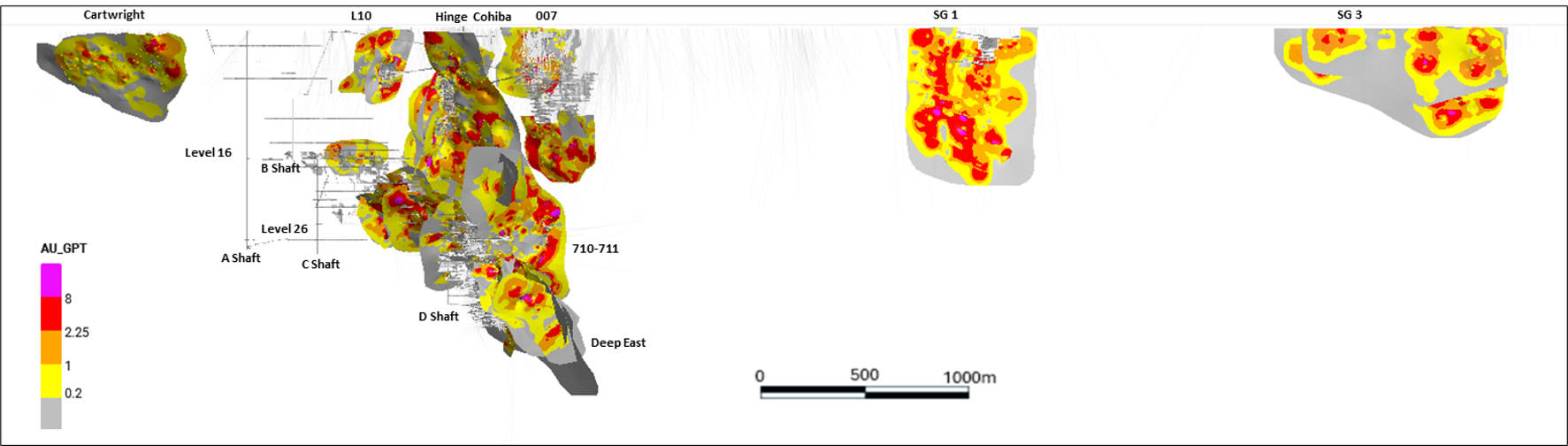
Figure: Block model - 3D Isometric View looking North
The PEA outlines a robust gold mining operation utilizing the fully built and permitted infrastructure, including shafts, underground workings, and the processing and tailings management facility. 1911 Gold has estimated the infrastructure replacement value as being in excess of $400 million. The True North PEA outlines a foundational mine plan based on the 2024 Mineral Resource Estimate, and targets steady-state production of 58,114 ounces per annum with a mine life of 11 years. The PEA also outlines a number of opportunities to improve metrics and with potential to increase the grade and production profile. View Opportunities

PEA Press Release

PEA Webinar Replay

PEA Presentation Download

PEA Highlights

PEA Highlights

  • Robust Economics (After-tax): NPV (5%) of $391 million, IRR 105%, and a payback period of 2.2 years at a long-term gold price of US$3,000 per ounce (“oz”); at a constant gold price of US$4,800/oz, the NPV is $998 million, no calculated IRR due to no years with a negative cash flow, and an almost immediate payback period of 1.0 year 
  • Production Profile: Steady-state production profile of 1,215 tpd for average payable gold production of 58,100 oz/year (Years 3-8) with an 11-year LOM
  • LOM Cash Flow: Total payable gold production of 527,136 oz LOM with the current mineral resources, generating $545 million undiscounted after-tax free cash flow and generating 326 full-time jobs 
  • Fully Permitted, Low Capital Project: Initial Capex of $59.2 million, utilizing the currently built and permitted payable infrastructure. Additional Capex of $46.7 million during the first 2 years of ramp-up, and $367.2 million of sustaining capital over LOM with a high profitability index of 6.6 and low peak investment of $59.2 million in Year 1 
  • Processing: Average diluted mill head grade of 4.32 g/t Au with gold recoveries of 93.5% over the LOM
  • Cash Costs and AISC1: Producing gold at a cash cost of US$1,390/oz and AISC of US$1,897/oz 
  • Near-Term Production: Production due to start in the first half of 2027 with test mining planned for the second half of 2026
  • Production Growth: 1911 Gold has identified excellent potential to increase production by developing recently discovered zones such as San Antonio Southeast (SAM SE), San Antonio West (SAM W), and Shore which are adjacent to existing infrastructure and not included in the study, in addition to regional targets.

PEA Overview

Sensitivities

1911 Gold has conducted a sensitivity analysis using the PEA financial model on the base case pre-tax and after-tax NPV and IRR of the Project, using the following variables: metal price, initial capex, total operating costs, and foreign exchange. Table 2 shows the after-tax sensitivity analysis results at various long term gold price assumptions.

As shown in Table 3 and Table 4, the sensitivity analysis revealed that the project is most sensitive to changes in gold prices, and foreign exchange and less sensitive to capital and operating costs.

PEA Sensitivities

Table 3: After-Tax NPV5% Sensitivity

Gold Price After-Tax NPV5% Initial CAPEX (CAD$M) Total OPEX ($CADM)) FX (CAD$M)
(US$/oz) (Base Case) (-25%) (+25%) (-25%) (+25%) (-25%) (+25%)
$2,000 ($41)  ($5) ($82)  $140 ($233)  ($322) $213
$2,600  $247 $283 $204 $371 $95 ($67) $476
$3,000  $391 $426  $348  $506 $268 $92 $647
$3,600  $595 $631 $552 $712 $478 $281 $902
$4,000 $731 $767 $688 $1,012 $785 $391 $1,066
$4,700  $971 $1,007 $928 $1,081 $853 $570 $1,365

Table 4: After-Tax IRR Summary

Gold Price After-Tax IRR Initial CAPEX (CAD$M) Total OPEX (CAD$M) FX (CAD$M)
(US$/oz) (Base Case) (-25%) (+25%) (-25%) (+25%) (-25%) (+25%)
$2,000  -2%  4% (6%)  28%  NA*  NA* 41% 
$2,600  50%  98%  31%  99% 20%   (6%) 167% 
$3,000  105%  420%  58%  214%  55%  19%  516%
$3,600    341%  NA*   119%  1,813% 159% 60% NA*
$4,000  1727% NA* 189% NA* 349% 105% NA*
$4,700  NA*  NA* 595% NA* NA* 289% NA*
Mining

True North will consist of underground mining extraction via four access points: the Main “A” Shaft, the Hinge decline, the Cohiba decline and later the SG-1 decline. Initial mining and development will be through the Main “A” shaft, providing access to Level 16 (-695 metres) and Level 26 (-1,145 metres), and the Hinge decline, maximizing current underground development to accelerate development and minimize initial capital costs. The initial plan for the development is to ramp up to a steady-state daily production rate of 1,215 tpd (from years 3-8).

The mineral deposits and zones used in the mine plan are contained in a number of deposit areas over a lateral distance of over 4,500 metres (‘m”) and down to depths of over 1,450 m below surface through a series of winzes and internal declines. The deposits are all amenable to underground mining using longitudinal long-hole open stope mining methods, with minimum dimensions of 25 m long by 1.5 m wide by 18 m high between sublevels, assuming 15% dilution with no gold grade and 97% mining recovery. The mining cycle will incorporate a strategic backfill plan, utilizing development waste rock to fill depleted stopes. This will enhance ground stability and significantly reduce operating costs by minimizing the volume of waste material required to be hoisted to surface, thereby optimizing available shaft capacity for high-grade ore.

Mining

Mining Methodology

Processing & Tailings Management

The fully permitted processing facility operated for a number of years and is reported to have produced 1.93 million oz of gold historically from 9.60 million tonnes at a grade of 6.65 g/t Au. The process plant consists of a crushing and grinding circuit, with a portion of the circulating load passed through gravity concentrators. The concentrate from the gravity concentration is upgraded on a shaking table and the resulting concentrate direct smelted. The tails from the concentration are returned to the head of the grinding mill and the fines from the grinding circuit are fed into a flotation circuit to produce a flotation concentrate which is reground and leached with the remaining process feed using a six-stage carbon-in-pulp (CIP) circuit. Dissolved gold is then eluted and gold doré is smelted and poured at site with an electric induction furnace.

Processing Facility

The Tailings Management Facility (TMF) is located 1.6 km north of the processing facility in an area naturally defined by bedrock ridges around the perimeter of a flat area. Tailings have been pumped from the processing facility to the TMF via pipeline. During mine operations the tailings are transported as slurry, with 34% solids by weight. An expansion of the facility was completed in 2015 with the construction of the East Tailings Management area, located immediately east of the TMF, including the polishing pond, where water is pumped in and discharged as required. Enough storage exists within the TMF for approximately 775,000 tonnes or over 2 years production under the PEA mine plan and permits are in place to expand the capacity of the TMF as needed.

TMF

Capital & Operating Costs

The total initial (pre-production) capital cost is estimated to be $59.2 million with an additional $46.7 million of capital during the first 2 years ramp-up period, prior to commercial production. Sustaining capital costs are estimated to be $367.2 million over the LOM (excluding $5.0 million of closure costs and salvage value).

Infrastructure Cape

Operating Costs

Production & Cash Flow Profile

A total of 4,066,000 tonnes at an average diluted grade of 4.32 g/t Au will be extracted under the current proposed plan for a total of 527,236 oz of payable gold produced.

Production Profile

The project is expected to generate $545 million undiscounted after-tax free cash flow (Base Case), and $1,314 million undiscounted after-tax free cash flow (at a gold price of US$4,800). Once operational, the mine is expected to support approximately 326 full-time positions, contributing to local employment and regional economic development.

Cash Flow

Labour & Economic Impact

1911 Gold is leveraging a highly experienced site leadership team that continues to attract top-tier technical talent to grow our workforce, while fostering a culture rooted in SAFETY, RESPONSIBILITY and OPERATIONAL EXCELLENCE

The project will see significant jobs creation and economic impact for the region, the province of Manitoba, and at the federal level as well.

Production Profile

1911 Gold Opportunities

The PEA results offer consideration of several initiatives that may enhance the Project.

Processing Capacity & Efficiencies:

  • Existing Processing Capacity - Additional capacity currently exists within the processing plant to increase throughput to the mill with additional mine production.
  • Expand Current Processing Facility - Ability to expand the capacity beyond the current processing capabilities of the plant, by upgrading the secondary crushing circuit and increasing CIP retention time with additional tank capacity

Waste Reduction and Operational Efficiencies:

  • Integrated Underground Waste Management – Potential to utilize development waste for rock filling depleted stopes, significantly reducing the volume of waste hoisted to the surface. This strategy is expected to lower operating costs and maximize available shaft capacity for high-grade mill feed.
  • Sensor-based Ore Sorting – Opportunity to implement ore sorting technology to reject waste rock before it reaches the processing facility. This would increase the effective head grade, lower tonnages to be transported and processed, and reduce processing costs per ounce. 
  • Advanced Backfill Solutions – Evaluation of tailings paste backfill underground to enhance ground stability and further minimize the surface environmental footprint.
  • Vertical Material Movement Optimization – Transitioning to internal ore passes and gravity-fed systems to move material to the shaft, reducing reliance on diesel-powered haulage and lowering ventilation requirements and related costs.

Additional Resource Opportunities:

  • Immediate Resource Expansion – Significant potential exists as extensions of the mineral resources used for the PEA mine plan due to the lack of sufficient drilling density.
  • Additional Resource Potential (Mine Footprint) – Recent exploration discoveries within the True North mine footprint occur adjacent to mine infrastructure, with high potential to add resources, including SAM W, SAM SE, and Shore.
  • Potential Addition of New Resources from Regional Targets – Additional resources and resource potential exists within the Rice Lake Greenstone Belt, over a 90-km strike length within 1911 Gold’s 100% owned ~62,000 hectares of ground. The Rice Lake Properties include the Ogama-Rockland gold deposit, all of which have road access, are within trucking distance to the mill, and are proximal to hydro-electric power.

1911 Gold is a true Hub and Spoke opportunity given its centrally located infrastructure and 90km strike length of prospective ground with numerous gold showings along with a number of past producing mines.

Hub and Spoke

PATH TO PRODUCTION

The following workflow is anticipated in preparation for True North to commence commercial gold production in 2027.

Path to Production

Stay up to date with our latest news: